Portfolios and External Coursework Submission

Template for all levels:

EnglishCourseworkTemplate(2018-19)

National 5

Completed Portfolios are due to me both electronically and in paper format by 4th March for grade estimates.

Final submission date after this is Friday 8th March

Higher

Completed Portfolios are due to me both electronically and in paper format by 11th March for grade estimates.

Final submission date after this is Friday 15th March

Advanced Higher:

Remember your final dissertation drafts, on the SQA template are due to me by the end of term. Emailed submissions are acceptable at this stage.

Referencing guidelines can be found here:

https://www.qub.ac.uk/cite2write/mhra.html

Plus, a really handy MHRA bibliography reference generator can be found here:

https://www.qub.ac.uk/cite2write/mhra3b.html
 

Scottish Text Revision

Today, the Higher class chose the story they wanted to focus on the most and started there. Following the revision guide sheet, they analysed the main themes in the story and then built towards specific textual analysis answers and practising 10-mark responses.

Set Text Revision

As an added bonus – Christmas music and Christmas jumper day lightened the atmosphere!

Medusa Critical Essay

National 5 – Intro to Critical Essay

Choose a poem which creates a particular mood or atmosphere.

By referring to poetic techniques, show how the poet creates this particular mood or

atmosphere.

Intro –

T – Title

A – Author

R – Refer to question

T – Techniques

‘Medusa’ by Carol Ann Duffy is a poem that deals with the character from Greek mythology, Medusa from an alternative perspective. Duffy creates the mood of anger throughout the poem by showing the inner turmoil of the narrator, Medusa. Duffy shows this by using techniques such as word choice, structure, sibilance and imagery.


P

E

E

L

(X2)


Medusa opens with the speaker of the poem discussing their mental state. It is clear to see that this includes some anger. The speaker says that the hairs on her head have turned to “filthy snakes”. The word “filthy” indicates something shameful and disgusting, which shows the reader the anger she feels when looking at her hair. This feeling continues when Medusa uses the image of her hair being like her thoughts “hissed and spat” on her scalp. The sibilance of the repeated ‘s’ sounds in hissed and spat make the reader think of snakes. Snakes are vicious and evil, traditionally, which indicates that Medusa’s thoughts are vicious. This therefore portrays a mood of anger.

Generic TA Questions – Iain Crichton Smith

With these questions, the pupils could test their knowledge of all four stories and practise their bullet-pointed TA layout.

  1. How does ICS create an effective introduction to this story? (4)
  2. How does ICS create an effective conclusion to this story? (4)
  3. How does ICS conveys an interesting character in this extract? (can choose own extract for this) (4)
  4. How does ICS express any of the main themes of the story? (4)

These could potentially build up to a massive 64 marks worth of practice, if pupils are dedicated!

With two hours to work on this in class, plus a full long weekend, I expect many interesting responses!

Higher Critical Reading

This week, the Higher class have been looking at some of the main themes explored in their final Iain Crichton Smith short story – home. After a collaborative task, the final details of the 6 given themes are collated below – with some themes providing basis for more discussion than others!

Theme notes Home

Off the back of this, the class were asked to choose the theme they felt they could write the most about and answer a 10-mark style answer on this. Responses were varied and interesting!

The class also had a look at a couple of trickier to analyse essay style questions on Havisham – They were to write plans on two then choose the one they felt the most confident about to produce a critical essay on. An example is attached below for anyone uncertain or who missed this lesson 🙂

Havisham Question Planning


Self-Assessment time!

Here are some examples of annotations you could have done on your Ian Crichton Smith short story introductions and conclusions.

ics-openings-and-conclusions-answers

Don’t worry if you didn’t get them all first try!

I have also done the technique definitions for you – but the examples are still up to you to find as we do the learning. Highers – you should have done all the learning required by now!

literary-technique-2018-19

🙂

Continuing work on Iain Crichton Smith’s ‘Home’.

This week, the Higher class has been exploring all the literary techniques they should know based on their previous learning. They have put this together in a table – an answer scheme to which can be found below.

Literary technique 2018-19

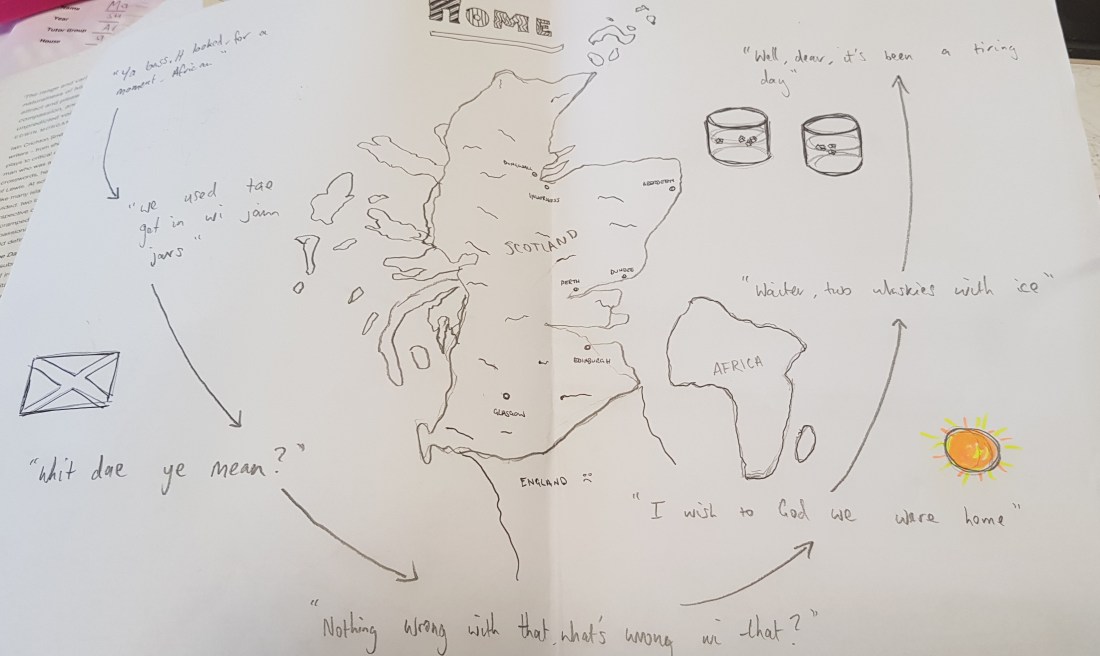
Both the Higher and National 5 classes explored the repression of Scots language within the story and what it showed about the main character’s identity. Here is one of many excellent creative demonstrations of this:

20181102_101034

Both the Highers and National 5s explored symbolism within the story ‘Home’ by Iain Crichton Smith. The symbols the classes found examples of and explained the significance of were:

  • The car
  • The people the characters remember from their past
  • Scotland
  • Africa
  • Scots Language
  • The colour blue
  • The cinema

Home – Ian Crichton Smith

The latest tasks for National 5 and Higher to explore understanding of the story were to complete a character profile for both the husband and wife we meet in the story. This included evidence of how each of them made their first impression as a character and how they developed.

After this, I selected 21 quotations from the story for annotation – this was to encourage learners to take a closer look at moments of the story in detail.

A challenge was posed after this: How can learners express the way Scots language and the main character go on a journey throughout the story?

Home first tasks